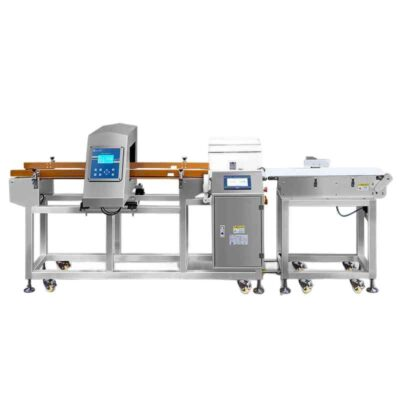
Industrial manufacturing environments rely on specialized electronic instruments to screen edible goods for hidden metallic contaminants before commercial distribution begins. A food metal detector functions as an automated inspection system that identifies stray ferrous, non-ferrous, and stainless steel particles embedded within continuous product streams.
Unlike standard weighing instruments, this technology utilizes electromagnetic fields to detect conductive materials without requiring physical contact with the food item. These systems act as a critical checkpoint in modern processing plants, safeguarding both consumer health and delicate downstream processing equipment.
Definition and Core Purpose in Processing Lines
At its core, a food metal detector operates as a non-destructive sensory device permanently mounted along active manufacturing lines. Its primary design purpose is to monitor moving product volumes for microscopic metallic intrusions that originate from upstream harvesting or machinery wear.
Agricultural equipment, processing blades, and transport containers frequently shed minute metallic fragments into raw ingredients. Without an active electromagnetic screening zone, these hidden hazards would travel undetected into consumer packaging, risking severe physical injury and costly product recalls.
Engineering specifications dictate that these inspection units must operate continuously under demanding factory conditions without losing baseline calibration. The electronic control unit continuously monitors voltage stability across the detection zone to isolate foreign objects from routine background noise.
By focusing strictly on electromagnetic disturbances, the device separates incoming food items from the metallic debris that may contaminate them during bulk handling. This precise identification capability makes the equipment an essential scientific component of industrial food safety architecture.
Internal Anatomy: Transmitter and Receiver Coil Configurations
The physical hardware of every inspection head centers around a rigid, non-metallic aperture lined with precision copper wire windings. Inside this protective structural housing, three distinct electromagnetic coils run parallel to one another across the width of the transport path.
The central winding acts as the transmitter coil, while the two outer windings function as balanced receiver coils. This symmetrical triple-coil geometry establishes a stable electromagnetic baseline when no metallic objects are present within the active scan zone.
Foodman designs these aperture frames using durable non-conductive composite materials to prevent structural interference with the internal magnetic fields. The physical spacing between the transmitter and receiver coils determines the overall sensitivity threshold of the machine.
Smaller apertures concentrate the magnetic flux more densely, allowing the system to detect significantly smaller spherical metal diameters than wide-belt configurations. Maintaining rigid mechanical stability within this coil assembly prevents thermal expansion or vibration from skewing the internal voltage balance during production.
The Electromagnetic Induction and Eddy Current Mechanism
Electromagnetic induction governs the fundamental detection mechanics whenever a product passes through the active aperture zone. An alternating electrical current flows continuously through the transmitter coil, generating a stable primary magnetic field that permeates the inspection space.
When a metallic particle enters this electromagnetic environment, the moving lines of force induce circular electrical currents inside the object. These localized phenomena, known as eddy currents, create a distinct secondary magnetic field that distorts the primary equilibrium established by the transmitter coil.
Dual receiver coils capture this voltage imbalance instantly, translating the tiny amplitude shift into a measurable electrical voltage signal. The phase and magnitude of this secondary signal vary depending on the magnetic permeability and electrical conductivity of the contaminant.
Ferrous metals possess high magnetic permeability, which amplifies the primary field and produces a strong, easily identifiable signal response. Non-ferrous metals and austenitic stainless steels rely primarily on electrical conductivity to generate their corresponding eddy current distortions.
Signal Phase Analysis and Product Effect Physics
Interpreting raw electrical disturbances requires sophisticated signal processing to separate genuine metal from harmless background interference. Many food products—such as fresh meats, high-moisture bakery items, and salted sauces—contain high levels of moisture and ionic salts.
These conductive properties generate their own secondary electromagnetic response when passing through the primary field, a physical phenomenon known as product effect. Foodman engineers implement advanced phase angle analysis to map the exact electrical signature of these food matrices.
By measuring the phase shift angle, the internal microprocessor distinguishes the unique electrical signature of metal from the broader conductivity profile of the food itself. Different materials alter the phase angle of the electromagnetic wave in predictable, quantifiable mathematical patterns.
The control system applies digital filters to ignore the harmless baseline shift caused by product moisture while isolating the sharp voltage spike of a metal particle. This advanced mathematical processing prevents false alarms while maintaining high sensitivity standards.
Structural Classifications: Conveyor, Pipeline, and Gravity Systems
Industrial processing requirements dictate that inspection equipment takes various physical forms depending on the target food consistency and packaging format. Conveyorized metal detectors feature integrated flat belts designed to transport packaged goods, boxes, or tray-packed items smoothly through the aperture.
Pipeline systems utilize enclosed tubular conduits specifically configured to screen pumpable liquids, pastes, emulsified meats, and viscous dairy products under pressure. Gravity-fall units are mounted vertically to inspect dry, free-flowing powders, grains, and snack foods as they tumble downward.
Each structural classification utilizes the same fundamental electromagnetic induction principles while adapting to the unique physical dynamics of the production line. Foodman Vision configures these diverse structural layouts to match unique factory sanitation demands and fluid movement characteristics.
The integration of multi-frequency capabilities within these different architectural formats ensures consistent detection across changing product recipes. Understanding these underlying electromagnetic mechanisms and structural types allows food manufacturers to comprehend exactly what a food metal detector is and how it functions at a technical level.
