On a crowded construction site, selecting a diesel boom lift is only part of the access problem. Procurement and site teams also need to decide where the machine will travel, where it can be positioned, how workers and materials will move around it, and how changing site conditions may affect operation. The best plan connects equipment capability with site logistics before delivery.
Start With the Work Zone, Not the Machine
Map the work area first. Identify the elevations that need to be reached, the locations where workers must perform tasks, and obstacles between the machine and those positions. Structural columns, temporary barriers, scaffolding, stored materials, and unfinished surfaces can all influence the machine’s route and final setup.
An access plan should also define exclusion zones and pedestrian routes. OSHA recommends inspecting aerial-lift work areas for holes, unstable surfaces, slopes, debris, overhead lines, obstructions, and severe weather before and during operation. On busy sites, these checks should be part of daily coordination.
Check Reach, Ground Conditions, and Traffic Flow
Working height should never be considered in isolation. Procurement teams should compare required platform height, horizontal outreach, and up-and-over access against the structure. An articulating configuration can be useful where the work position is offset from the machine base or the boom must move around obstacles.
Ground conditions and traffic flow are equally important. A diesel boom lift may need to cross haul routes, pass through controlled gates, or work near other mobile equipment. Verify available width, turning space, ground conditions, slopes, and movement sequences. OSHA also requires manufacturers’ boom and basket load limits to be observed.
Plan the Stowed Envelope and Daily Movement
Busy sites often become more congested as construction progresses. Procurement documents should therefore capture stowed length, width, height, weight, turning radius, and travel requirements. These dimensions help logistics teams determine whether equipment can enter the site, pass temporary access points, and reach planned staging areas.
Daily movement deserves the same attention. Decide when the machine will travel, which routes are shared with trucks or pedestrians, and where it will be parked. A written traffic plan can reduce conflicts caused by last-minute repositioning and make equipment availability more predictable across crews.
Match Power to the Site Schedule
Power selection should reflect the environment and work pattern. Diesel equipment may suit demanding outdoor applications, but teams should still review fuel access, refueling arrangements, emissions requirements, operating hours, and local restrictions. The objective is to match the power system to the planned working cycle.
A diesel boom lift also needs time and space for routine inspection and servicing. OSHA states that pre-start inspections should be completed before each shift and should cover vehicle and lift components, controls, tires, hydraulic and fuel systems, safety devices, and other relevant parts.
Build the Requirement Around Site Coordination
Equipment selection becomes clearer when the requirement is written as a site brief. Include the highest work point, horizontal access needs, maximum platform load, travel distances, ground conditions, access dimensions, power expectations, operating environment, and required documentation. This gives suppliers measurable criteria and makes quotations easier to compare.
The brief should also identify responsibilities for route planning, daily inspections, operator coordination, and work-zone control. OSHA specifies that only trained persons operate aerial lifts and requires work-area inspections for hazards. These responsibilities belong in project planning rather than being separated from procurement.
Where the Zoomlion ZA14J Fits
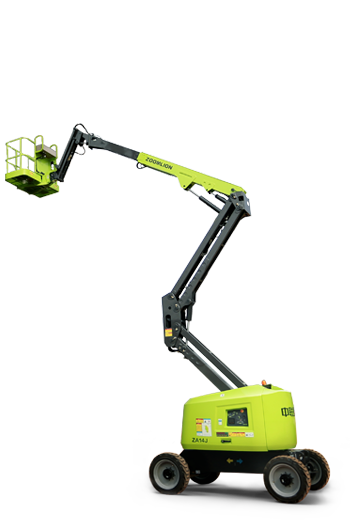
The Zoomlion ZA14J is a diesel articulating boom lift listed by Zoomlion Access for precise positioning and flexibility. Their official product page specifies a maximum working height of 15.80 m, platform height of 13.80 m, horizontal outreach of 8.30 m, and up-and-over height of 7.55 m. Platform capacity is 300 kg and gross weight is 7,100 kg.
For crowded construction environments, its published dimensions are also relevant. The Zoomlion ZA14J has a stowed length of 6.57 m, width of 2.30 m, and height of 2.27 m. The specification lists 4WD, 45% gradeability, 6.8 km/h drive speed, and 355° non-continuous turntable swing. These figures help teams review routes and positioning before mobilization.
Equipment Details for Procurement Reviews
Zoomlion Access states that they offer more than 100 MEWPs across five core categories, including scissor lifts, telescopic boom lifts, articulating boom lifts, spider lifts, and telehandlers. Their current global portfolio also includes telehandler attachments, vertical mast lifts, vehicle-mounted boom lifts, and forklifts.
For the Zoomlion ZA14J, the product page highlights a multiple-pressure-control leveling system, load-sensing system, rotary reducer, optional hostile kits for dusty environments, and a deadweight lowering system. Listed diesel engine options are Kubota V2403 and Kubota D1105. Buyers can compare these details with site requirements before finalizing the equipment specification.
Turn Site Constraints Into a Clear Equipment Brief
A successful access plan connects the machine to the construction sequence. Before ordering, confirm the route, working envelope, platform load, traffic controls, ground conditions, power arrangements, inspection procedures, and storage location. This helps prevent a capable machine from becoming difficult to deploy because of overlooked site constraints.
For buyers assessing the Zoomlion ZA14J, published specifications can serve as measurable inputs to the site plan, alongside operating procedures, local requirements, and project conditions. Zoomlion Access provides a broad equipment portfolio, allowing procurement teams to assess the relevant equipment category against the actual access challenge rather than selecting by working height alone.
