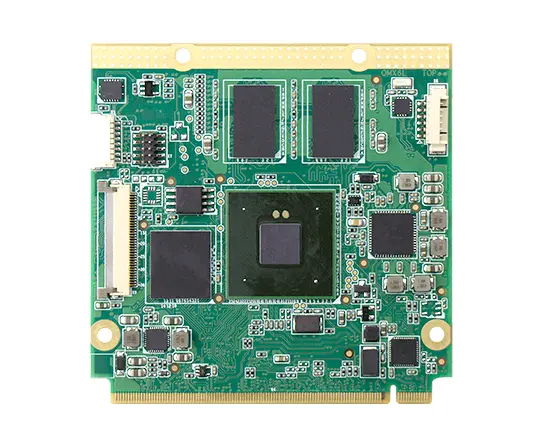
If you are comparing a Q-seven SOM with an OSM module for an industrial product, the key question is not which board looks smaller. It is how the module standard affects carrier-board design, serviceability, software migration, and supply risk. Vantron’s System-on-Module portfolio provides a useful reference because it spans both formats.
Qseven and OSM are both open module standards, but they make different physical and commercial tradeoffs. One is normally a plug-in module on a carrier; the other is commonly soldered to the carrier. That difference reaches into prototyping, field repair, enclosure design, and long-term product planning.
What the Two Module Standards Actually Define
A System-on-Module packages computing functions on a compact board. The processor, memory, storage support, and core system interfaces stay on the module. Your carrier board adds application-specific power, connectors, displays, sensors, fieldbus links, and expansion. The standard defines how these boards communicate, but it does not design your product for you.
Qseven generally uses a removable module connected to a carrier. That approach supports bench testing and replacement during development. OSM, or Open Standard Module, uses soldered contacts on the module underside. The carrier receives the module directly, which can reduce the connector stack and suit compact equipment, but it changes how you handle repair and upgrades.
Picture an AGV controller being tested beside a warehouse lane. A plug-in module lets an engineer exchange the compute core while keeping the carrier and motor interfaces unchanged. A soldered OSM design can make the finished controller thinner and mechanically stable, yet a failed module is no longer a simple field swap. The service model should influence the standard before the schematic is frozen.
Is Qseven or OSM Easier to Integrate?
Neither standard removes carrier-board work. You still need to map power sequencing, boot storage, display output, USB, Ethernet, camera inputs, debug access, and application I/O. Mark each signal as required, optional, multiplexed, or unavailable.
A Qseven module uses a standardized connector interface, allowing your team to develop and test a carrier board with a selected compute module rather than placing the processor section directly on the carrier. This separation can help organize a project that expects module revisions or needs to compare supported processor options. It does not remove carrier validation: connector retention, signal integrity, firmware behavior, and the mechanical stack-up still need checking, particularly in a vibrating machine. The trade-off is added mechanical height and connector cost.
An Open Standard Module can suit a sealed handheld instrument, a small medical monitor, or a compact retail terminal where space and mechanical simplicity matter. Its direct mounting can shorten the path between the module and carrier, but it usually requires more careful manufacturing and rework planning. A standard module does not remove the need to validate soldering, thermal transfer, and production test access.
Pinout and I/O Decide More Than the Module Label
Open standards provide a common language, not identical products. Two Qseven modules can expose different processor capabilities, memory arrangements, graphics features, or optional interfaces. OSM variants also differ by size, pin count, module type, and supported signals. Your comparison should begin with the exact version and module type, then continue through the supplier’s pinout and design guide.
A factory vision controller may need several camera links, fast storage, and predictable display timing. A QSR self-order kiosk may care more about display outputs, USB peripherals, audio, and service access. A vehicle computer may prioritize serial interfaces, Ethernet, CAN connectivity, and vibration control. The module label matters less than the signal map behind the application.
Processor choice adds another layer. An ARM design using NXP i.MX8 or i.MX9 can follow a different software and power strategy from an Intel x86 design. MediaTek Genio, Qualcomm, Rockchip, and TI platforms bring their own board support and acceleration paths. Treat these as platform decisions, not automatic benefits of Qseven or OSM.
Software, Thermal Design, and Lifecycle Change Total Cost
Vantron describes its System-on-Module portfolio as supporting Android, Linux, and Windows, and its category page also mentions evaluation kits and ready-to-use operating systems. These statements describe the portfolio rather than a uniform configuration for every module. Before selecting a module for your carrier board, verify the model-specific OS version, BSP, drivers, boot behavior, graphics support, update path, and application compatibility. Include this verification in total-cost planning: unsupported drivers, application-porting work, or a required software migration can add bring-up effort and maintenance work over the product lifecycle.
Thermal planning follows the same rule. A removable module may need clearance for its connector and a defined heat path into the enclosure. A soldered module can support a lower mechanical profile, yet the carrier, enclosure, and production fixture still need to move heat away from the processor. A fanless design only stays within its thermal envelope when airflow, ambient conditions, and load are considered together.
Lifecycle support belongs in the same review as engineering effort. Vantron has worked in embedded computing for more than 20 years, employs over 200 research personnel from a variety of fields, and provides FAE technical support. Those figures do not prove that one module matches your project, but they give a sourcing team concrete topics to verify: processor availability, software maintenance, evaluation support, and the process for handling a revision.
Choose the Standard by Service and Program Risk
Choose Qseven when your product benefits from a replaceable module, repeated carrier reuse, easier bench-level upgrades, or a software environment aligned with the selected plug-in platform. Choose OSM when a compact, soldered design fits the enclosure, the production process can support it, and the program accepts a less convenient field replacement path. In both cases, choose by signal map and lifecycle plan, not by form factor alone.
Before approving the design, score carrier reuse, module replacement, software migration, thermal margin, manufacturing access, and long-term supply separately. Then test the decision against the real deployment: an AGV on a warehouse floor, a medical cart, or a self-service kiosk. That exercise exposes tradeoffs that a simple size comparison hides.
A final review can cover the selected standard, operating system, I/O, enclosure, validation fixtures, and replacement plan. Vantron is one example of a portfolio that includes both Qseven and OSM options, along with other System-on-Module formats. The useful outcome is a documented decision rule that production, engineering, and procurement can all use.
