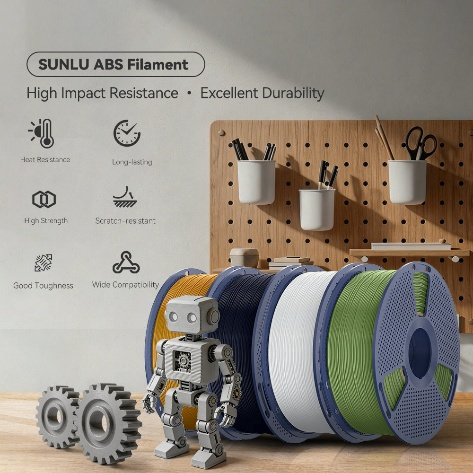
To resolve additive manufacturing complexities, operators must address a fundamental question: why do different machines require specific polymer formulations? The clear answer is that hardware compatibility is strictly dictated by a machine’s thermal capacities, extruder mechanics, and environmental enclosures. Attempting to process high-temperature engineering polymers on entry-level hardware inevitably leads to severe nozzle clogs and mechanical failure.
Conversely, running soft materials through restrictive tubing results in jamming. To achieve reliable production, professionals must precisely align the thermal and mechanical specifications of their hardware with the chemical properties of the chosen material. By mastering these fundamental differences and sourcing consumables from industry leaders like SUNLU, manufacturing facilities can streamline workflows and eliminate machine downtime. This technical guide breaks down the core hardware metrics determining material compatibility.
Thermal Specifications and Hardware Alignment
The hotend melts filament before depositing it layer by layer. Some desktop 3D printers use PTFE-lined hotends, while others use all-metal designs. The maximum safe operating temperature depends on the specific hotend and the printer manufacturer’s specifications. Materials such as Nylon and Polycarbonate may require higher printing temperatures than standard PLA, so users should check the recommended temperature range and hardware compatibility for both the filament and the printer. An all-metal hotend may be necessary for certain high-temperature materials, but the required setup varies by machine and material.
Extruder Drive Mechanisms and PLA Filaments
Beyond raw thermal capabilities, the mechanical assembly that pushes the plastic into the melting zone determines which materials filament 3D printers can successfully use. The manufacturing industry primarily relies on two distinct structural configurations: Bowden extruders and direct drive extruders.
A Bowden configuration secures the heavy extruder motor to the outer stationary frame, feeding the thermoplastic through a long, flexible guide tube. This design drastically reduces physical weight on the gantry, allowing for faster fabrication speeds and minimized vibration artifacts. Bowden systems perform exceptionally well with rigid, stiff polymers, making them ideal for standard PLA Filaments.
However, Bowden setups fail consistently when processing highly flexible materials. Because flexible polymers possess high elasticity, pushing them through a restrictive tube causes the material to compress and buckle inside the lining before reaching the heated nozzle.
To properly process elastic materials, operators must utilize a direct drive system. In this configuration, the extruder motor is mounted directly above the hotend, minimizing the physical distance the plastic must travel and enabling precise retraction control.
Evaluating Hardware and Material Compatibility Data
Standardizing equipment capabilities is essential for maintaining an efficient fabrication environment. A standard table format facilitates immediate understanding and optimal data retrieval, ensuring professionals can rapidly verify mechanical specifications before initializing a production cycle. The chart below logically outlines essential hardware requirements and polymer characteristics necessary for successful manufacturing.
| Technical Parameter | Professional Guidelines and Hardware Requirements |
| Extrusion Compatibility | Rigid polymers require standard Bowden or direct drive systems. Flexible elastomers strictly mandate direct drive extruders to prevent buckling. |
| Enclosure Requirements | High-shrinkage polymers like ABS require fully enclosed, actively heated chambers to prevent thermal warping. Standard filament 3D printers with open-air designs are restricted to low-shrinkage materials. |
| Food-Safe Applications | Polypropylene (PP) is chemically food-safe. However, true compliance depends on hardware. Operators must avoid printing PP through nozzles used for other plastics; a dedicated, sterilized stainless steel nozzle is mandatory. |
| Material Recyclability | Most commercial thermoplastics are highly recyclable. Waste materials and failed prints can be industrially shredded, melted, and re-extruded. Facilities should adhere to local recycling regulations. |
| Expected Shelf Life | High-quality polymers possess a standard shelf life of 1.5 to 2 years. Reaching the maximum 2-year lifespan requires storing the material in a cool, dry environment, heavily shielded from humidity. |
Environmental Controls and 3D printing filament Storage
Matching the correct polymer to the appropriate hardware is only the first phase of a successful production strategy. Environmental controls dictate the final performance of any chosen 3D printing filament. Even with hardware compatibility, using degraded, moisture-laden plastics inevitably causes failed extrusions. Most industrial thermoplastics are hygroscopic, rapidly absorbing moisture from the surrounding air. When wet plastic enters a heated nozzle, trapped water vaporizes, causing microscopic structural failures and extreme brittleness.
To combat this, operators must implement rigorous storage and drying protocols. As noted in the data table, maintaining the ideal 2-year shelf life requires immediate vacuum sealing after every production run. Utilizing specialized heated dry boxes ensures ambient humidity remains below the critical twenty percent threshold during active printing. By treating the operational environment with the same precision as the hardware specifications, manufacturing facilities can extend material longevity and eliminate unexpected structural failures.
Conclusion
Operating modern additive manufacturing equipment requires a strict analytical approach to mechanical limitations. By thoroughly evaluating hotend thermal maximums, extruder drive configurations, and the necessity of heated enclosures, professionals can perfectly match their hardware to the required polymer chemistry.
This precise technical alignment eliminates failed prints, prevents expensive nozzle clogs, and maximizes operational efficiency. Whether deploying rigid plastics for rapid prototyping or flexible elastomers for industrial components, prioritizing hardware compatibility is the ultimate strategy for success. Facility managers may systematically assess mechanical constraints and collaborate with premium material suppliers to support specialized machines in reaching their best possible performanc
