Small printing businesses need equipment that can handle customized orders, maintain consistent output, and control operating costs without requiring a complex production setup. UV direct-to-film printing offers an opportunity to produce decorative transfers for hard-surface products, including glassware, metal accessories, acrylic items, and plastic goods. For businesses entering this market, choosing the right machine means balancing production capacity, automation, application flexibility, and long-term operating expenses.
Expand Product Opportunities Without a Complex Workflow
UV DTF printing creates designs on specialized transfer film using UV-curable inks. The printed design is laminated and transferred onto a suitable surface, allowing businesses to decorate products without placing each finished item inside a printer. This approach can simplify customization for irregularly shaped objects and small batches.
A UV DTF printer for small business can support applications such as branded drinkware, promotional merchandise, packaging decorations, personalized gifts, and product labels. These applications allow print shops to serve retailers, corporate customers, event organizers, and independent brands with different design requirements.
However, businesses should test the intended substrates before accepting commercial orders. Surface coatings, texture, cleanliness, and material compatibility affect adhesion and finished quality. Clear application guidelines and sample testing help reduce waste when introducing new products.
Evaluate Integrated Printing and Laminating
A turnkey system combines essential production functions in a coordinated setup, reducing the need to purchase and configure separate equipment. For UV DTF operations, integrating printing and laminating can simplify film handling and help establish a repeatable workflow.
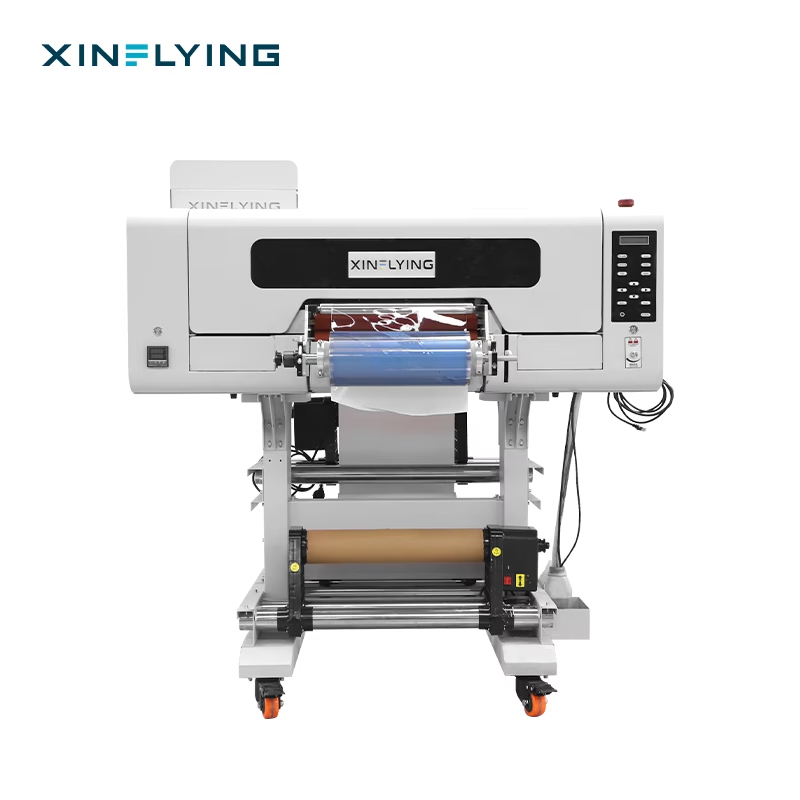
Xinflying’s XF-450S UV 3PC Epson Print Head UV DTF Printer combines UV printing and laminating in one compact system. Its three Epson i1600-U1 printheads support detailed transfer production, while air-cooled UV curing lamps help cure ink during printing. The system is designed for producing crystal labels and decorative transfers.
For a UV DTF printer for small business, integration can be valuable when floor space and staffing are limited. Nevertheless, buyers should confirm which accessories, software, and installation services are included in the quotation. A turnkey package should be evaluated by its complete production workflow, not simply by the number of functions advertised.
Match Printing Capacity to Expected Orders
Equipment capacity should reflect realistic demand rather than an ambitious estimate of future sales. A machine with excessive capacity may tie up capital, while an undersized system can create bottlenecks when orders increase.
The XF-450S has a listed 12-inch printing width and a rated printing speed of 2.75 m²/h in 8-pass mode. Its three Epson i1600-U1 printheads provide a defined hardware configuration for buyers comparing output capabilities. The published machine dimensions are 1,300 × 1,000 × 1,450 mm, so workspace planning remains important.
Actual production rates depend on artwork coverage, print settings, media handling, and maintenance. Buyers should request sample output and estimate daily production using their typical designs. This makes it easier to determine whether the machine can meet delivery commitments without relying on headline speed alone.
Consider Automation and Operational Protection
For smaller teams, equipment that reduces operator intervention can improve workflow consistency. Features such as ink-level alerts and printhead protection help operators identify potential problems before they cause avoidable interruptions.
The XF-450S includes printhead anti-collision protection and a large-capacity ink supply with a low-ink alarm. Its precision motion-control system supports accurate printhead movement, while the integrated curing and laminating workflow helps simplify production.
When assessing a UV DTF printer manufacturer, buyers should examine these practical safeguards alongside print quality and speed. They should also ask about routine cleaning, ink compatibility, replacement parts, and recommended maintenance intervals. Automation can reduce certain operational risks, but it does not eliminate the need for trained operators and regular equipment care.
Calculate the Total Cost of Ownership
The equipment purchase is only one component of the startup investment. UV inks, A/B films, cleaning materials, electricity, maintenance, packaging, and labor all contribute to the cost of producing saleable transfers. Businesses should also account for failed prints and material wasted during setup.
A useful approach is to calculate the total cost of a representative production batch and divide it by the number of acceptable transfers. This provides a more realistic unit cost for pricing custom orders and estimating gross margins.
A reliable UV DTF printer manufacturer should provide clear specifications and guidance on compatible consumables. Buyers should request an itemized quotation covering the machine, software, training, shipping, warranty, and any optional accessories. Comparing these details helps prevent an apparently affordable purchase from becoming more expensive after installation.
Assess Supplier Support Before Making a Decision
Technical support can be particularly important for businesses without an experienced in-house technician. Installation guidance, troubleshooting assistance, operator training, and access to spare parts may affect how quickly production resumes after a problem.
Xinflying supplies digital printing equipment for commercial customization applications. Buyers considering the XF-450S should verify the applicable warranty terms, support channels, spare-part availability, and consumable requirements before ordering. They should also confirm electrical requirements and installation arrangements for their location.
A capable supplier should explain the machine’s strengths and limitations rather than promise that one configuration suits every application. Testing representative materials and reviewing written documentation are practical ways to validate whether the equipment meets a business’s needs.
Build a Scalable Custom Printing Business
An entry-level investment makes sense when it aligns with customer demand, available workspace, and achievable production targets. Integrated printing and laminating, manageable operating costs, and suitable technical support can help a small business establish a repeatable workflow before expanding.
For businesses evaluating a UV DTF printer for small business, the XF-450S offers a defined three-printhead configuration, 12-inch printing width, and integrated laminating functions. By checking application compatibility, calculating total ownership costs, and comparing supplier commitments, buyers can determine whether this Xinflying system is a practical foundation for their customization business.
