Large commercial sites rarely stay clean through occasional sweeping alone. Dust, grit, packaging, tire residue, and tracked-in dirt accumulate across parking facilities, campuses, logistics yards, and pedestrian areas.
Ride-on cleaning equipment helps teams cover broad surfaces with less manual effort. The right choice depends on what the surface collects, which cleaning processes are required, and how the investment performs over time.
- Understand the Main Machine Types
A ride on sweeper gathers dry debris with brushes, suction, or a combination of collection systems. It suits outdoor areas where leaves, loose litter, and dust are common.
A floor scrubber applies cleaning solution and agitation to loosen adhered dirt, then collects the wastewater. Combination machines bring more than one process together, but their actual functions vary by model.
The term ride on sweeper scrubber is often used broadly, so specifications matter more than the label. Check whether the machine includes brush or pad scrubbing, water recovery, vacuum collection, dust suppression, or high-pressure washing.
These processes solve different problems. A unit that sprays water and pressure-washes a surface is not automatically equivalent to a conventional scrubber with a solution tank and recovery system.
- Match the Equipment to the Site
Start with the area to be cleaned and the debris found there. Parking areas and industrial yards usually need strong collection for grit, leaves, and small litter. Pedestrian plazas and transit entrances often require quieter operation and maneuverability around people. Indoor floors can have different ventilation, moisture, and surface restrictions than outdoor pavement.
Measure route width, turning space, ramps, gradients, and the time available between busy periods. Compare cleaning width and realistic output, not only the manufacturer’s maximum rate.
Furniture, parked vehicles, crowd flow, and edge work reduce actual coverage. Battery runtime also needs to accommodate travel, collection-bin emptying, water refills, and routine checks.
A well-matched ride on sweeper scrubber can simplify daily operations. Divide the site into zones, set cleaning frequency by use, and identify areas that need separate washing or manual detailing. This makes performance easier to track and steers clear of paying for features that rarely contribute to the task.
- Check Productivity and Operating Fit
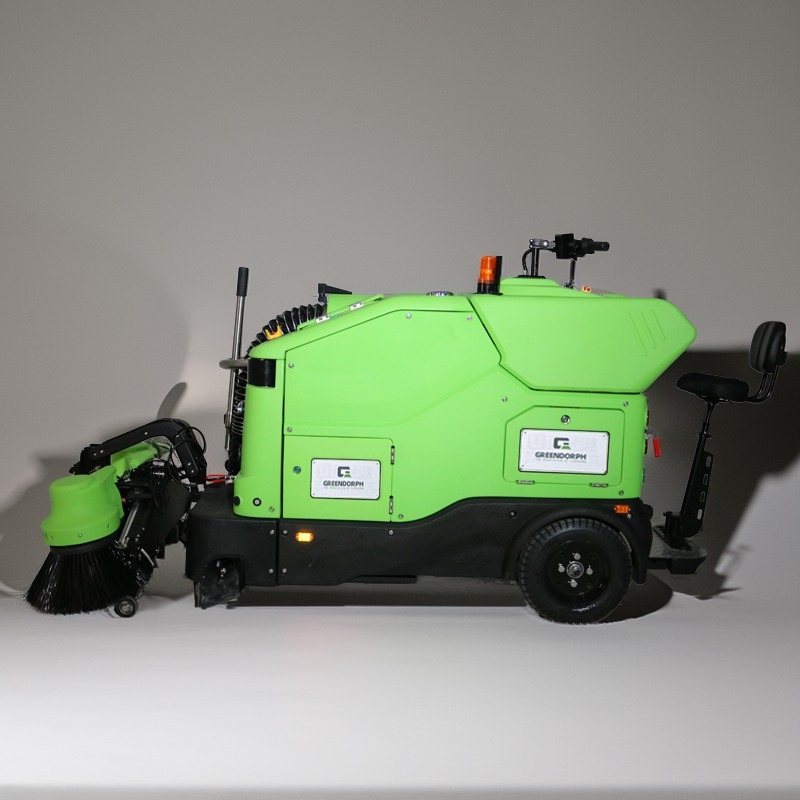
The Greendorph Omniclean Urban Street Sweeper YJ80 is designed for urban outdoor cleaning, including sidewalks, plazas, and parking areas. It has a cleaning width of 140 cm and a rated cleaning efficiency of 10,800 m² per hour.
Average operating time is listed at 6–8 hours, supported by a 48V/300Ah lithium iron phosphate battery. Actual results depend on layout, debris load, operator practice, and service stops.
The YJ80 combines sweeping, vacuuming, and blowing with water spraying and high-pressure water washing. It also offers manual ride-on, auto-following, and towed-traction modes. Before treating it as a full ride on sweeper scrubber replacement, compare the required cleaning method with the functions specified for the site’s floor or pavement conditions.
Other practical checks include waste-bin capacity, water capacity, dimensions, climbing ability, service access, parts availability, and training requirements. The YJ80 lists a 120 L water tank and a waste-bin capacity of 100 L + 12 L. Confirm how those capacities fit the expected route and debris volume before estimating how often the machine will stop for servicing.
- Calculate Return on Investment
Purchase price is only the starting point. A realistic cost model includes operator hours, charging electricity, water, consumables, scheduled maintenance, repairs, training, and downtime. Compare those costs with the current method, including manual labor, separate equipment, contractor charges, and repeat cleaning.
A simple ROI calculation is:
Annual net benefit ÷ initial investment × 100 = annual ROI percentage.
Estimate annual net benefit by subtracting the new machine’s annual operating cost from the annual cost of the current approach, then adding defensible savings from reduced equipment overlap or fewer repeat passes.
Use actual shift records and supplier cost information instead of assuming catalog coverage becomes real-world output. A payback period can be estimated by dividing the initial investment by annual net savings.
Run conservative, expected, and high-use scenarios. Include maintenance downtime and seasonal changes, and do not count labor savings unless schedules or staffing can realistically change. This helps keep an attractive calculation from hiding operating constraints.
- Plan for Long-Term Value
A ride on sweeper is a better investment when staff can operate it safely and maintain it consistently. Review pre-start inspections, charging procedures, waste disposal, water handling, and cleaning around pedestrians.
Keep records of completed routes, operating hours, maintenance tasks, and recurring problem areas. Those records help show whether the equipment is producing the expected coverage.
Greendorph develops commercial cleaning equipment for outdoor environments, and its YJ80 brings several dry and wet cleaning functions into one electric platform. Reviewing official specifications alongside a site trial gives operations teams a clearer basis for comparing performance, service needs, and total ownership cost.
Strong ROI comes from matching the machine to the work and measuring results after deployment, not selecting equipment by headline capacity alone.
